

Trenchless Pipe Rehabilitation: Renew Your Network Without Tearing Up the Street
How CIPP technology and UV curing systems allow water utilities to restore their pipeline infrastructure in hours, not weeks — no trenches, no road closures, and a lower total cost
Water and wastewater networks face a silent challenge: much of the infrastructure installed 30, 40, or more than 50 years ago has reached the end of its service life. Recurring leaks, infiltration, root intrusion, corrosion, and partial collapses translate into water losses, sinkholes, and ever-increasing operating costs.
The traditional response — excavate, remove the damaged pipe, and install a new one — means breaking pavement, closing roads for weeks, disrupting businesses and residents, and absorbing civil works costs that often exceed the value of the pipe itself.
There is a proven alternative used worldwide: trenchless pipe rehabilitation.
What is trenchless rehabilitation (CIPP)?
The CIPP technique (Cured-In-Place Pipe) consists of inserting a flexible felt or fiberglass liner impregnated with resin into the existing pipe. Once in place, the liner is expanded against the inner wall of the pipe and cured — hardened — until it forms a new structural pipe inside the old one.
The result is a continuous, jointless, corrosion-resistant pipe with a design life of 50 years or more, installed through existing manholes without opening a single trench.
UV curing: the modern standard
Within CIPP technologies, ultraviolet (UV) light curing systems represent the state of the art. Instead of curing the resin with hot water or steam over several hours, a train of UV lamps travels through the interior of the fiberglass liner, hardening it in a controlled process monitored in real time.
The advantages are clear:
- Speed: entire segments rehabilitated in hours, not days.
- Quality control: the process is recorded with cameras and sensors; every cured meter is documented.
- Greater structural strength: fiberglass liners achieve superior mechanical properties with thinner walls, preserving the hydraulic capacity of the pipe.
- Smaller environmental footprint: no process water, no discharges, and more compact equipment on site.
Spot repairs: you don't always need to rehabilitate the entire segment
When the damage is localized — a displaced joint, a crack, a defective lateral connection — the most efficient solution is spot (point) rehabilitation. Systems such as Quick-Lock stainless steel mechanical sleeves seal the damaged point from the inside, installed by robot and verified through CCTV video inspection, with no excavation and no prolonged service interruption.
The complete workflow: diagnose, rehabilitate, verify
A successful rehabilitation doesn't start with the liner: it starts with the diagnosis. The typical process integrates several technologies working together:
- CCTV video inspection to assess the real condition of the pipe and classify defects.
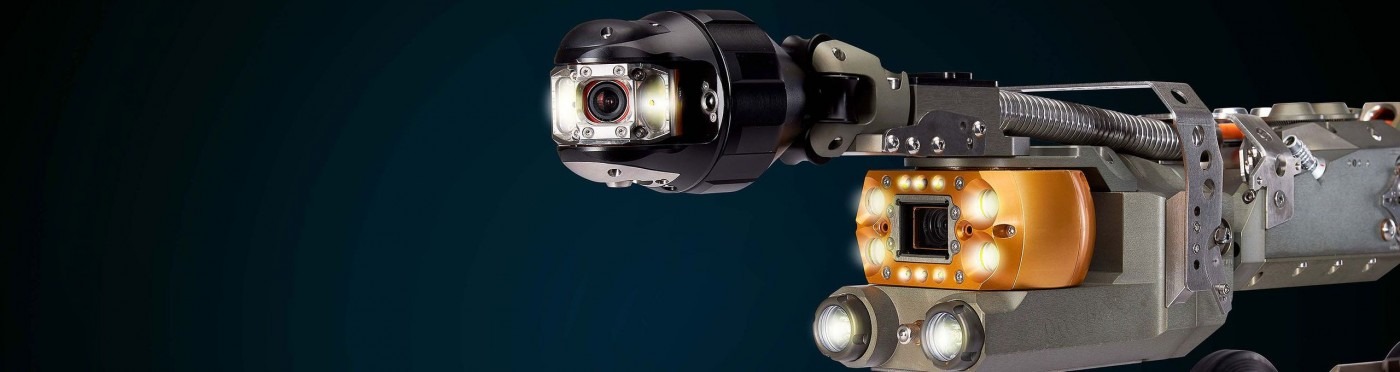
- Cutting robots (electric, hydraulic, or pneumatic) to remove roots, protrusions, and obstructions, and to reopen lateral connections after curing.
- Pipe plugs to isolate the work segment and control flows during the intervention.
- Installation and curing of the CIPP liner or the spot-repair sleeve.
- Final CCTV inspection to document and certify the quality of the rehabilitation.
Why does it make sense for water utilities?
| Criterion | Traditional excavation | Trenchless rehabilitation |
|---|---|---|
| Execution time | Weeks | Hours / days |
| Traffic and social disruption | High | Minimal |
| Civil works and pavement restoration cost | Very high | Practically none |
| Service life of the solution | 50 years | 50 years or more |
| Service interruption | Prolonged | Brief and scheduled |
When you consider the total cost — including repaving, detours, impact on local businesses, and management time — trenchless rehabilitation is in most cases the most economical option, as well as the fastest and the one with the least impact on the community.
Marfel: technology, equipment, and support
At Marfel Ambiente, Agua y Energía we deliver the complete trenchless rehabilitation solution: UV curing systems, CIPP liners, Quick-Lock spot repairs, cutting robots, pipe plugs, and high-definition CCTV video inspection systems, along with the training and technical support water utilities and contractors need to adopt these technologies successfully.
Our contribution is clear: guaranteeing access to water for future generations by increasing network efficiency with innovative solutions.
Does your network need a diagnosis? Contact us at contacto@marfel.mx or learn more at marfelusa.com.